
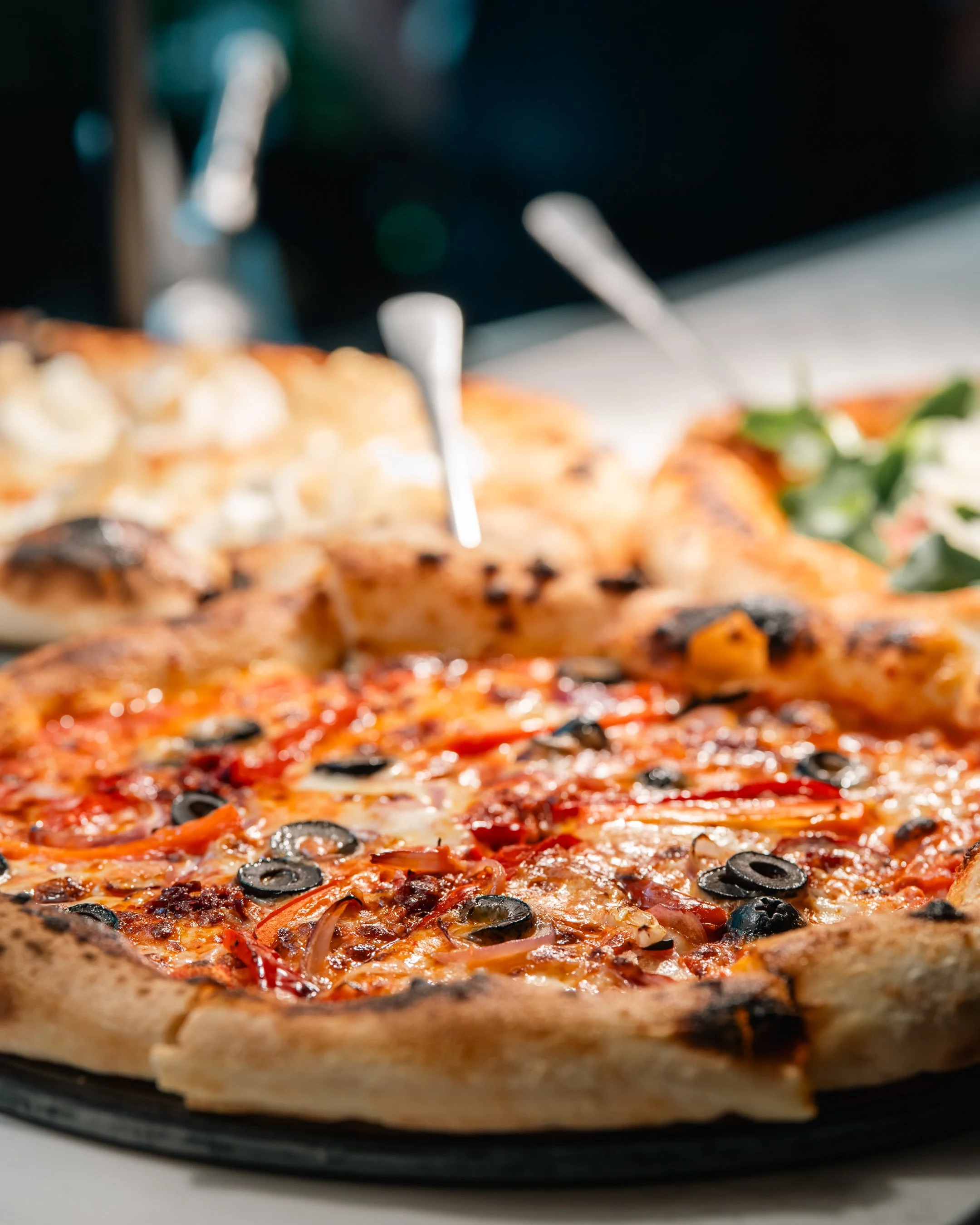
Pizza can be wonderfully simple: dough, tomato, mozzarella and a few carefully chosen ingredients.
Yet within that simplicity, there can be an enormous amount of variety.
Across Italy, different kinds of pizza reflect regional ingredients, local tastes and different approaches to the balance between dough and toppings. Some pizzas are tomato-based, while others have no tomato at all. Some rely on just three or four ingredients. Others bring together cheeses, cured meats, vegetables or truffle for something altogether richer.
For anyone exploring Italian food, understanding the different types of pizza is a good place to start — and a good excuse to order a few different ones for the table.
What Makes an Italian Pizza?
There isn't just one definition of Italian pizza.
Styles vary considerably across Italy, but one principle runs through many of them: the toppings shouldn't overwhelm the dough.
The base matters.
At Tavolo, our pizza dough is proofed for 72 hours, allowing it time to develop before it reaches the oven. We use a relatively small amount of yeast and give the dough time to ferment gradually.
The result is a pizza where the crust is meant to be eaten and enjoyed as part of the dish — rather than simply serving as a vehicle for the toppings.
From there, the ingredients determine what kind of pizza it becomes.
Margherita: The Italian Classic
If you want to understand Pizza Italia, the Margherita is a natural place to begin.
It is one of the simplest and most recognisable Italian pizzas: tomato, mozzarella and basil.
Precisely because there are so few ingredients, there is nowhere for them to hide. The tomato needs flavour, the mozzarella needs balance, and the crust needs enough character to stand on its own.
At Tavolo, our Margherita uses San Marzano tomato sauce, mozzarella and basil.
Simple doesn't necessarily mean plain. With pizza, simplicity can often reveal the most.
Pizza for Cheese Lovers
Remove the tomato and pizza takes on a completely different character.
Cheese-based pizzas, often described as pizza bianca when made without tomato sauce, allow different cheeses to provide the flavour, richness and texture.
Our 7 Formaggi takes this idea further with seven cheeses: mozzarella, Parmigiano Reggiano, Pecorino Romano, Gorgonzola, Pepato, smoked Scamorza and Stracciatella.
Each contributes something different — from sharpness and saltiness to creaminess and smoke.
For something more earthy, Tartufo e Burrata combines mozzarella, black truffle sauce, Pecorino Romano and fresh burrata.
These are richer pizzas, but balance still matters. The goal isn't simply to add more cheese; it is to create contrast between different flavours and textures.
Pizza with Italian Cured Meats
Cured meats are another familiar part of Italian food, but they can create very different pizzas depending on what accompanies them.
A Spicy Salami pizza keeps things direct: San Marzano tomato, mozzarella and spicy salami.
Prosciutto e Rucola takes a different direction, balancing tomato and mozzarella with Prosciutto di Parma and the peppery freshness of arugula.
Then there is Mortadella e Burrata, where mozzarella and mortadella are paired with fresh burrata and pistachio. It is creamy, savoury and slightly nutty — and noticeably different from a traditional tomato-based pizza.
The meat may attract your attention first, but what surrounds it determines the character of the pizza.
Pizza with Mushrooms, Sausage and Vegetables
Vegetables can be just as important to pizza as meat or cheese.
Funghi e Salsiccia combines mozzarella and Portobello mushrooms with handmade Italian sausage and Parmigiano Reggiano. The earthiness of the mushrooms works naturally with the savoury sausage.
For a meat-free option, Vegetariana brings together San Marzano tomato, mozzarella, eggplant, bell pepper and red onion.
Again, the idea is balance: enough toppings to make every slice interesting without losing the pizza underneath.
Regional Inspiration: Calabrese and Piemontese
Pizza can also offer a way into Italy's regional flavours.
Our Calabrese looks south to Calabria, combining San Marzano tomato, mozzarella, ’nduja, bell pepper, red onion and black olive.
'Nduja — Calabria's distinctive spicy, spreadable salume — gives the pizza considerably more heat and intensity than a Margherita or Prosciutto e Rucola.
The Piemontese, meanwhile, moves north.
Inspired by the region that strongly influences Tavolo's cooking, it combines mozzarella, black truffle sauce, Gorgonzola, asparagus, beef tartare and bagna cauda.
They are two very different pizzas, and a reminder that there is no single flavour that defines Italian cooking. Travelling from one Italian region to another can change what appears on the table considerably.
And What About Calzone?
A calzone begins with pizza dough but changes the experience completely.
Instead of being served open, the dough is folded over its filling before cooking. The ingredients are enclosed inside, creating a softer, more contained centre surrounded by baked crust.
At Tavolo, there are two versions.
Our Smoked Calzone combines mozzarella, smoked Scamorza, Portobello mushrooms and smoked ham, while the Salami Calzone takes a more classic tomato-based direction with San Marzano tomato, mozzarella and spicy salami.
Pizza or calzone? They share the same family, but eating them is an entirely different experience — one is meant for the middle of the table, the other is happily kept to yourself.
So, Which Kind of Pizza Should You Choose?
There is no single "best" pizza. It depends on what you feel like eating.
If you want something classic and uncomplicated, start with a Margherita.
If you enjoy cheese, try a Formaggi or a pizza with burrata.
For something savoury, look toward prosciutto, mortadella, sausage or salami.
If you prefer stronger flavours, truffle, Gorgonzola or 'nduja can take the pizza in a completely different direction.
And if you want to explore Italian cooking beyond the familiar classics, look for pizzas inspired by specific regions of Italy.
The differences are part of what makes pizza worth ordering a few at a time and sharing around the table.
Looking for Italian Pizza in Makati?
If you're searching for Italian food near me, or comparing italian restaurants near me before deciding where to go, it's worth looking past the toppings and paying attention to the dough underneath.
The fermentation, ingredients and balance of a pizza all make a difference — and at Tavolo, a restaurant in Makati near Greenbelt, that starts with dough proofed for 72 hours. From familiar Italian classics like Margherita and Prosciutto e Rucola to pizzas inspired by Calabria and Piemonte, there's a version for whatever you're in the mood for.
Whether you're after a Greenbelt restaurant for a weekday lunch, sharing pizza over dinner with friends, or simply searching for pizza in Makati worth going back to, there's more than one way to gather around a good pizza.
Sometimes the best place to begin is with the simplest question: what kind of pizza are you in the mood for today?
Join us at Tavolo and find out.